


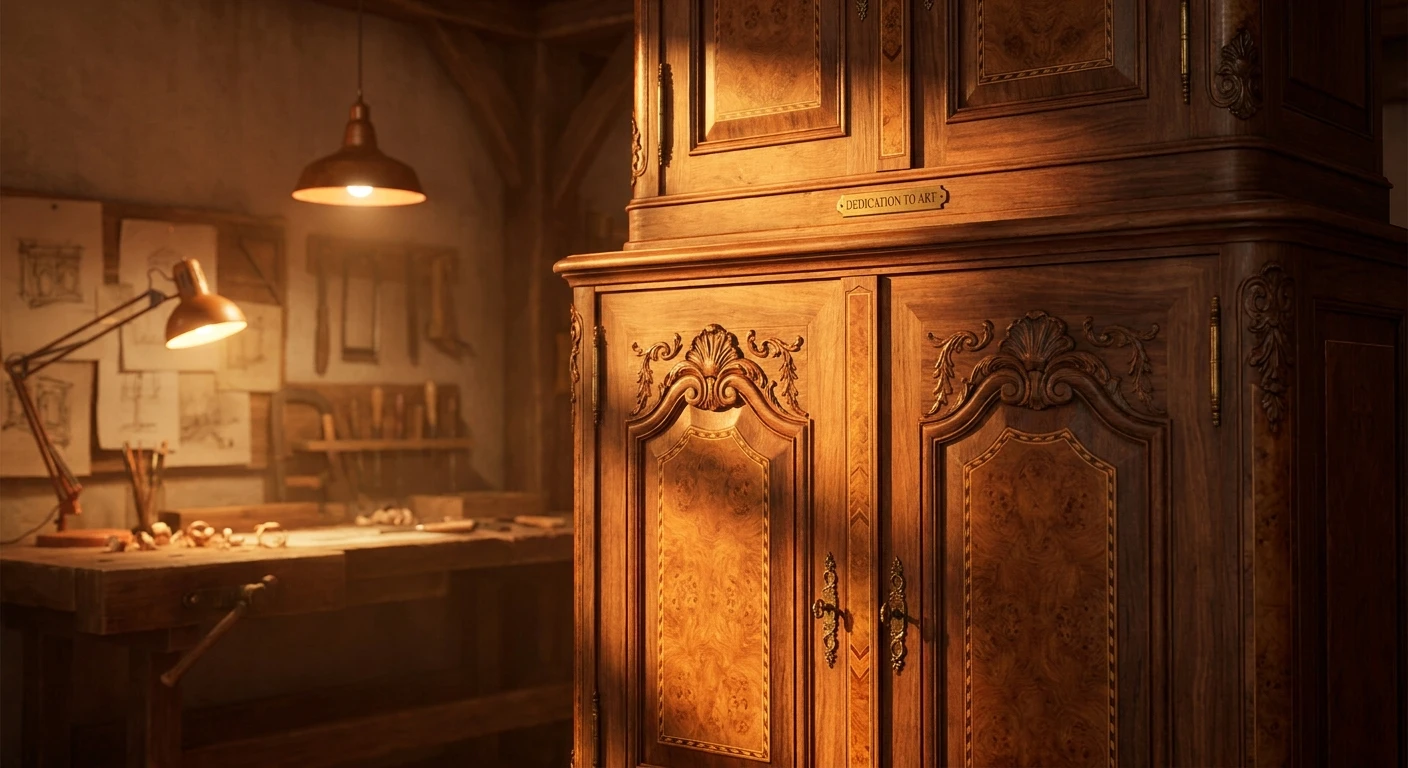
The Unmatched Artistry of charles radtke
You know that feeling when you see something so perfectly made, you just have to stop and stare? That is exactly what happens when you look at the masterworks of charles radtke for the very first time. I still remember scrolling through a design forum late one night, totally exhausted, when a picture of his cabinetry stopped me dead in my tracks. It was not just furniture; it was a profound statement of dedication. Growing up in Ukraine, I spent my childhood summers near the Carpathian mountains, watching local artisans carve intricate patterns into thick oak and beech wood. They poured their souls into every single cut, honoring centuries of tradition. Seeing the precision in these modern studio pieces brought all those memories rushing back. The sheer discipline required to manipulate organic materials into flawless geometric harmony is mind-blowing. My goal right now is to break down exactly why his approach to functional art stands head and shoulders above standard woodworking, giving you a deep appreciation for the meticulous planning behind every single hinge, veneer, and hidden drawer.
To truly grasp the genius behind his craftsmanship, we need to look at the core benefits of collecting and studying high-end studio furniture. You are not just buying a place to store your keys; you are acquiring a physical narrative. His cabinets often feature complex internal structures that challenge the viewer to interact physically with the piece. When you open a door, you might find another set of doors, followed by a secret compartment. This interactive element creates an intimate bond between the object and the owner. Two brilliant examples of this ethos are the ‘Cranbrook Cabinet’ and the ‘Contemplation Cabinet.’ Both pieces require the user to engage deeply, solving a mild mechanical puzzle just to access the interior spaces. The value proposition here is simple: absolute aesthetic beauty paired with unparalleled mechanical functionality.
Read also: Tour the canucks practice facility Now; Why michael grange Leads Modern Sports Media.
| Masterpiece Name | Primary Materials Used | Defining Hidden Feature |
|---|---|---|
| The Cranbrook Cabinet | Macassar Ebony & Bronze | Concealed secondary locking mechanism |
| The Contemplation Cabinet | Swiss Pearwood & Silk | Nested interior drawers with blind pulls |
| The Sentinel Box | Wenge & Holly | Spring-loaded false bottom panel |
If you want to understand why his creations resonate so deeply with collectors globally, look at these three foundational pillars of his work:
- Absolute Precision Joinery: Every single dovetail and mortise is cut with a level of accuracy that rivals aerospace engineering. There are zero gaps, ensuring the piece lasts for generations without structural failure.
- Emotional Narrative Architecture: The furniture tells a story. The exterior might be austere and protective, while the interior is warm, detailed, and inviting. It mimics human nature perfectly.
- Unyielding Functional Integrity: No matter how beautiful the piece is, it functions flawlessly. Doors swing open on custom-made hinges without a whisper of friction, and drawers glide effortlessly despite changes in humidity.
Origins of a Master Maker
Everyone starts somewhere, and the journey from a novice woodworker to a world-renowned studio furniture artist is paved with thousands of hours of unseen labor. The early days were marked by a relentless pursuit of foundational skills. Before you can break the rules of design, you have to master the rules of construction. Learning how different species of timber behave, how they cup, bow, and twist under various environmental conditions, is a rite of passage. He spent years honing his ability to read the grain, understanding exactly how a specific board would look once finished and placed next to a contrasting timber. It is this grueling foundational period that separates amateur hobbyists from true masters of the craft.
The Evolution of Studio Furniture
As the years progressed, the work evolved from traditional forms into something entirely distinct. The shift happened when standard cabinetry began to feel too restrictive. Integrating architectural concepts and narrative themes became the new standard. Instead of just making a box with doors, the focus shifted to creating a self-contained environment. The introduction of custom-machined hardware was a massive turning point. Relying on store-bought hinges and locks simply was not enough anymore. By fabricating his own metalwork, he ensured that every single millimeter of the piece was completely under his creative control. This holistic approach completely changed the trajectory of his career, elevating the furniture into the realm of fine art sculpture.
Modern State of the Craft
Fast forward to the year 2026, and the landscape of studio furniture is more fascinating than ever. While many mass-production companies rely heavily on CNC machines and automated assembly lines, the demand for truly handcrafted, bespoke art has actually skyrocketed. People are craving authenticity. They want items that carry the fingerprint of the maker. His current state of work reflects a mastery that only comes from decades of muscle memory and artistic vision. The pieces being produced now are incredibly refined, showcasing an effortless blend of rare materials, complex mechanics, and profound conceptual depth. Collectors are more eager than ever to acquire pieces that offer a tactile, grounding experience in an increasingly digital world.
The Anatomy of Wood Movement
Let us talk about the actual science behind building something that lasts a century. Wood is a hygroscopic material, meaning it constantly absorbs and releases moisture depending on the relative humidity of its environment. When you build a complex cabinet with tightly fitted doors and drawers, you are essentially trying to tame a living, breathing material. If you trap a solid wood panel inside a rigid frame without leaving room for expansion, the piece will literally tear itself apart during the humid summer months. The engineering required to mitigate this stress is staggering. Frame and panel construction is just the beginning. Advanced techniques involve carefully calculating the exact moisture content of the timber before making a single cut.
Engineering Invisible Joinery
Creating seamless transitions between different pieces of wood requires a deep understanding of cellular structure and adhesive science. When you look at his cabinets, you often cannot tell how they are held together. The joinery is entirely internal. This is not just for aesthetics; it protects the glue lines from environmental degradation. Here are some of the critical scientific realities that dictate how high-end studio furniture is engineered:
- Moisture Equilibrium: Timber must be acclimated to the specific microclimate where it will ultimately reside, usually around 6% to 8% moisture content for interior furniture.
- Tensile vs. Compressive Strength: Different joints are utilized based on the directional forces applied to them. Dovetails handle tensile stress, while mortise and tenons handle shear and compressive loads.
- Adhesive Cross-Linking: High-performance glues create a bond at the molecular level, often resulting in a joint that is significantly stronger than the surrounding wood fibers themselves.
- Veneer Substrate Stability: Exotic veneers must be pressed onto dimensionally stable substrates, like high-grade MDF or specialized plywood, to prevent catastrophic cracking over time.
Day 1: Establishing the Baseline
If you want to truly appreciate this level of artistry, you need a structured approach. Start your week by looking up his earliest recorded works. Pay close attention to the traditional forms he utilized before developing his signature style. Notice the choice of wood species and the proportions of the cabinets. Write down three things that stand out to you about his early aesthetic choices.
Day 2: Analyzing Material Selection
On the second day, focus entirely on the materials. Look at the contrast between the dark, brooding exterior woods like Macassar Ebony and the bright, surprising interiors made of Holly or Pearwood. Think about how this contrast affects your emotional reaction to the piece. Does it feel protective? Does it feel secretive?
Day 3: Decoding the Hidden Compartments
Spend your third day searching for videos or detailed descriptions of the mechanical features. Try to understand the logic behind the hidden compartments. They are never random. They usually require a specific sequence of actions to open, almost like a ritual. Sketch out how you think a spring-loaded false panel actually works.
Day 4: Studying the Hardware
Day four is all about the metalwork. Since standard hinges are rarely used in these masterpieces, look closely at the custom brass, bronze, or silver hardware. Notice how the hinges are often completely concealed when the doors are closed, maintaining the pure, uninterrupted lines of the wooden exterior.
Day 5: The Architectural Connection
By day five, you should start seeing the architectural influences. Compare his cabinets to brutalist or modernist buildings. You will notice similar themes: strong vertical lines, heavy massing, and a distinct separation between public exterior spaces and private interior spaces. The furniture is essentially micro-architecture.
Day 6: Virtual Gallery Tour
Take the sixth day to visit museum websites that feature his work in their permanent collections. Read the curatorial notes. Seeing how professional art historians contextualize his work within the broader studio furniture movement will give you a completely new vocabulary to describe what you are seeing.
Day 7: Applying the Philosophy
On your final day, take these principles and apply them to your own life. You do not have to be a woodworker. Just look around your space. Are the objects you own built with intention? Do they have a narrative? Start prioritizing extreme quality and thoughtful design in whatever medium you work in, bringing that same relentless dedication to your own daily tasks.
Myth: High-end studio cabinetry is just basic carpentry with more expensive wood.
Reality: Comparing basic carpentry to studio furniture is like comparing a bicycle to a Formula 1 race car. The engineering tolerances, custom mechanics, and conceptual design phases take hundreds of hours before construction even begins.
Myth: The hidden compartments are purely a gimmick to impress buyers.
Reality: The secret spaces serve a deep narrative purpose. They force the user to slow down, be present, and interact intimately with the object, transforming passive storage into an active, emotional experience.
Myth: You need massive, heavy machinery to build pieces like this.
Reality: While machines rough out the dimensions, the flawless final fit is almost exclusively achieved using traditional hand tools, razor-sharp chisels, and custom hand planes manipulated entirely by human muscle and intuition.
Myth: These pieces are too delicate to actually be used in a normal home.
Reality: They are engineered to outlast the people who buy them. The internal joinery is incredibly robust, designed specifically to withstand daily operation for multiple generations without failing.
Who exactly is he?
He is an American master craftsman and studio furniture maker celebrated for creating highly architectural, narrative-driven cabinets that blend flawless woodworking with custom mechanics.
What is his most famous type of work?
He is best known for his intricately designed cabinets that feature austere exteriors contrasting with rich, complex interiors full of hidden compartments and secret drawers.
How long does a single piece take to make?
Depending on the complexity, a single cabinet can easily take anywhere from several hundred to over a thousand hours of dedicated, focused labor.
Does he use traditional hand tools?
Yes, while modern machinery is used for initial milling, the precision joinery and final surface preparations are primarily executed with meticulously tuned hand tools.
Where can I see these pieces in person?
His work has been featured in prestigious galleries and is held in the permanent collections of major institutions like the Renwick Gallery of the Smithsonian American Art Museum.
What is the core philosophy behind his art?
The core philosophy centers on the physical interaction between the user and the object, demanding mindfulness and respect through mechanical puzzles and breathtaking aesthetic surprises.
Are these cabinets considered fine art?
Absolutely. They transcend mere utility and are collected globally as highly significant pieces of contemporary sculptural art.
Understanding the dedication required to produce work at this level completely changes how you view the objects in your everyday life. The sheer tenacity it takes to master both the artistic vision and the uncompromising physics of wood movement is a testament to human potential. The legacy of charles radtke proves that functional objects can indeed touch the soul. Do not just take my word for it—go find a gallery or a museum exhibition showcasing his brilliant cabinets, and experience the profound beauty of true craftsmanship for yourself today!