

Your Ultimate Mixed Doubles Curling Schedule Breakdown
Look, if you want to catch the best ice action this season, getting your hands on the official mixed doubles curling schedule is your absolute first move. I was just sitting in a cozy little coffee shop near Khreshchatyk Street here in Kyiv, scrolling through my phone, trying to figure out exactly when the next big international match was happening. It struck me how frustrating it can be to track down precise dates and times for these fast-paced games. We don’t have massive, dedicated curling arenas on every single corner in Ukraine, so when we decide to tune in, we want to know exactly when those heavy granite stones are gliding down the ice. This guide right here is your ultimate playbook for tracking every slide, sweep, and final score.
I am giving you the straight facts, entirely filler-free. Whether you are a casual sports fan who just likes watching the fascinating sweeping mechanics or a hardcore statistician tracking every single tournament point, knowing exactly when and where these athletes hit the ice changes how you experience the sport. It completely shifts your viewing strategy from reactive to proactive. By the time you finish reading this breakdown, you will have a rock-solid plan to follow the entire global circuit without missing a single hammer throw or power play. Let us get straight to the facts and build your perfect viewing calendar.
The Core Mechanics of Tournament Timing
Understanding how the calendar works requires looking at the sheer speed of this specific format. Mixed doubles is completely different from the traditional four-player team game. You have only two players per team, fewer stones in play, and a drastically faster pace. The schedule strictly reflects this high intensity. Teams often play multiple games in a single day, forcing organizers to pack matches tightly into a weekend or a fast-paced week-long window.
| Event Type | Typical Format | Usual Time of Year |
|---|---|---|
| World Championship | Round Robin to Playoffs | Late April |
| Grand Slam Events | Triple Knockout | October through January |
| National Qualifiers | Group Stages | Early February |
| Olympic Trials | Double Round Robin | November (Pre-Olympic Year) |
There is massive value in actually memorizing or bookmarking these timelines. For one, it makes planning watch parties with your friends incredibly easy. You know exactly when to order food and clear out your weekend. Secondly, if you are running a fantasy sports league, knowing when double-header days occur gives you a massive competitive edge over folks who just blindly pick players. You can stack your roster based on who has the most favorable matches on a given Tuesday.
Here are three major reasons why keeping a close eye on the tournament timings boosts your fan experience:
- You never miss a morning draw: Morning games often feature the freshest ice conditions, leading to wildly aggressive takeout strategies that you simply do not see in evening matches.
- You can track player fatigue: Because these athletes throw and sweep their own stones, a team playing their third game in 24 hours is going to show physical exhaustion, affecting their late-game accuracy.
- You can anticipate playoff brackets early: By knowing the exact dates of the final round-robin sessions, you can calculate tie-breaker scenarios before the broadcasters even announce them.
The Unlikely Origins of Mixed Doubles
The concept of a two-person team didn’t just appear overnight. Back in the early 2000s, this format was essentially treated as a fun, casual offshoot. Local clubs would run two-person events just to fill empty ice time on Sunday afternoons. The scheduling was completely informal. You would literally just show up, throw some stones, and see who scored highest. No one thought it would evolve into a massive international broadcast event. Traditionalists were highly skeptical, believing the sport required four minds to properly execute ice strategy.
The Evolution of Tournament Timelines
As the format grew in popularity, the scheduling became a total logistical nightmare. Early on, organizers tried to tack these two-player events onto the very end of traditional four-player tournaments. This meant the mixed doubles matches were played on terribly chewed-up ice late at night. Players hated it, and fans were usually too tired to stay in the stands. Eventually, governing bodies realized this high-speed version of the sport needed its own dedicated calendar. They started carving out exclusive weeks in the season strictly for the duo format, allowing ice makers to prepare the surface specifically for their unique aggressive playstyle.
The Modern State of the Competitive Calendar
Today, the calendar is a meticulously organized machine. Looking at the 2026 season, you can see just how pristine the planning has become. Events are spaced globally to allow athletes time to travel from Canada to Europe to Asia without burning out completely. The modern circuit demands respect. Broadcasters now bid massive amounts of money for primetime slots, meaning the biggest matches are deliberately placed on weekend evenings to capture the maximum possible audience. It is a far cry from the Sunday morning pickup games of twenty years ago.
The Physics Behind Ice Preparation Timings
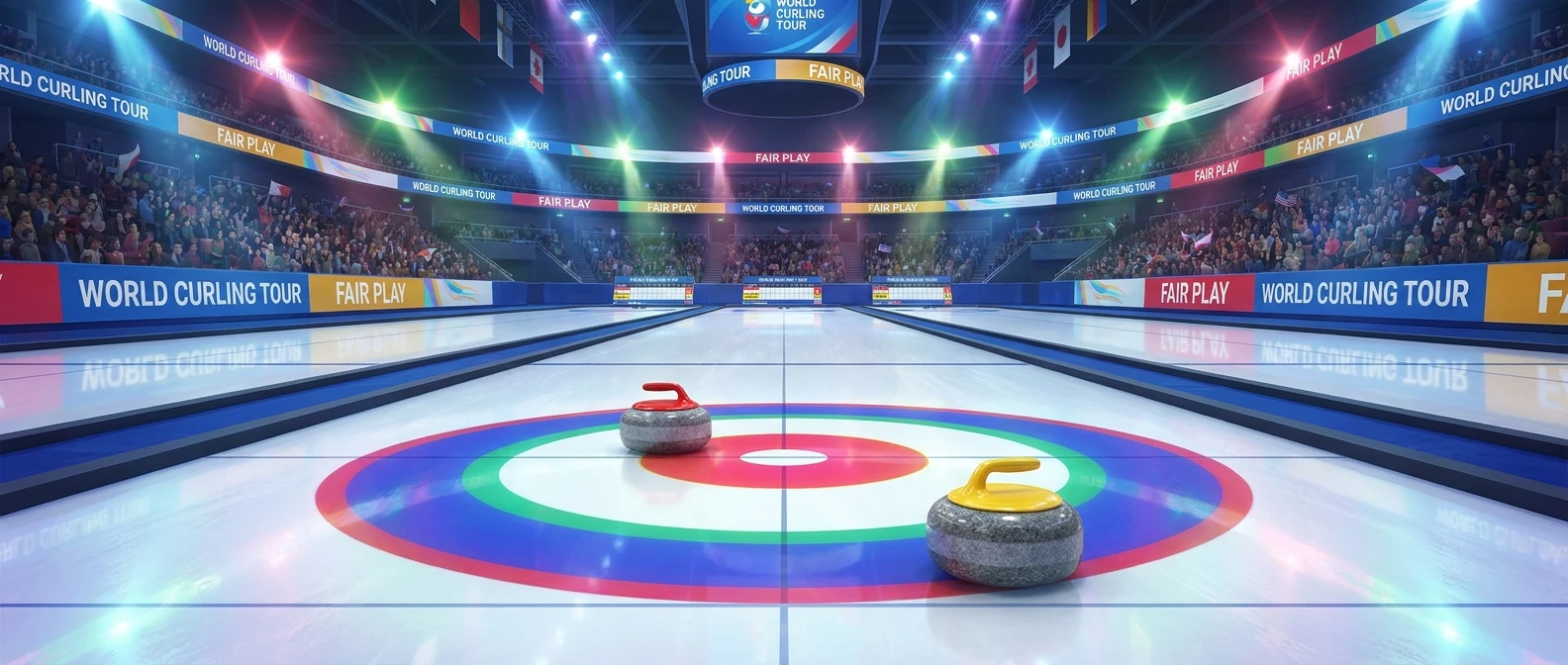
You cannot talk about match timings without talking about the actual science of the ice. The downtime between matches is not just for TV commercials; it is a strict scientific necessity. Ice makers need exactly 45 to 60 minutes between draws to scrape the ice perfectly flat and apply a fresh layer of ‘pebble’. The pebble is the frozen droplets of water that the heavy granite stones glide across. Without proper pebble, the stones would just suction to the flat ice and stop dead.
The timing of these matches directly impacts the friction coefficients of the playing surface. When an arena is packed with thousands of fans, the ambient body heat raises the building’s temperature, which subtly melts the microscopic tops of the pebble. This makes the ice ‘faster’ but also harder to control.
- Water Purity: Ice makers use reverse osmosis to strip all minerals from the water, ensuring the pebble freezes instantly upon contact with the surface.
- Droplet Freezing Times: The temperature of the water used for pebbling is carefully calibrated to freeze within milliseconds, creating distinct microscopic bumps.
- Friction Coefficients: As a game progresses over two hours, the aggressive sweeping literally melts the pebble temporarily, creating a micro-layer of water that reduces friction and allows the stone to travel up to ten feet further.
- Humidity Management: The HVAC systems in the arena are timed to run aggressively during breaks to suck out the moisture generated by the athletes’ sweat and breath.
Biomechanics and Player Recovery Windows
The gap between games is also heavily dictated by human biomechanics. In traditional formats, you have two dedicated sweepers. Here, the person who throws the stone often has to immediately jump up and start sweeping their own shot. The heart rate spikes massively. Players are operating at a near-sprint level of anaerobic output for eight ends. If the schedule forces a team to play back-to-back games with only an hour of rest, lactic acid buildup heavily degrades their fine motor skills. This is exactly why you will see top-tier teams making rare tactical errors in evening matches if they already played a grueling extra-end game that morning.
Day 1: Opening Draw Familiarization
When a major week-long tournament kicks off, Day 1 is all about reading the ice. Every single arena has different water, different cooling pipes, and different humidity. The matches on the first day are usually cautious. Teams are throwing exploratory shots, figuring out how much the stone is going to curve or ‘curl’. Your goal as a fan on Day 1 is just to figure out who has adapted to the building fastest.
Day 2: The Mid-Morning Strategic Sweeps
By the second day, the hesitations are gone. Teams know the ice paths now. The morning draws on Day 2 are fantastic because players are fresh, they slept well, and they are ready to aggressively attack the center of the house. Watch for teams trying to set up complex guard walls early in the end.
Day 3: Analyzing Power Play Utilization
Mixed doubles features a unique rule called the Power Play, where teams can shift the pre-placed stones to the side of the sheet. As the 2026 season shows, Day 3 is when teams start desperately using this mechanic to secure essential mid-tournament wins. They cannot afford to fall to the middle of the pack. You will see some brilliant, high-risk shot making here.
Day 4: Managing Mid-Tournament Fatigue
This is the slump day. Players have likely played five or six games by now. Shoulders are aching, and knees are bruised from sliding. The schedule becomes a war of attrition. The smartest teams will simplify their strategy on Day 4, throwing hard hits rather than relying on delicate, finesse draw shots that require perfectly calibrated sweeping.
Day 5: The Critical Cut-Off Matches
It is do-or-die time. The round-robin is wrapping up. Every single point matters for tie-breakers. If you are going to call in sick to work to watch curling, Day 5 is the day. Teams that are on the bubble of elimination will play with reckless abandon, attempting miracle shots because they literally have nothing left to lose.
Day 6: Semi-Final Intensity Peaks
The field is narrowed down to the elite. The arena is usually much quieter on Day 6 because the tension is so thick. The ice makers also spend extra time preparing the sheet, making it faster and more challenging. Strategy here slows down; players take their full allotted time clocks to discuss every possible angle.
Day 7: Championship Sunday Showdown
The absolute pinnacle of the schedule. Just two teams left. All the fatigue is masked by pure adrenaline. The stones are polished, the crowd is hyped, and every single shot is a highlight reel waiting to happen. Grab your favorite drink, sit back, and watch the masters go to work.
Myths vs. Reality on the Ice
Myth: The schedule is exactly the same as traditional curling.
Reality: It is radically different. Mixed doubles crams significantly more games into a tighter window because the matches are physically shorter. They only play eight ends instead of the traditional ten, and there are fewer stones thrown per end.
Myth: Morning draws are boring and slow.
Reality: Quite the opposite! Morning games frequently feature the freshest, fastest ice conditions. Because the ice hasn’t been worn down by hours of play, you actually see the most aggressive, high-speed takeout strategies before noon.
Myth: You can just tune in on Sunday and skip the rest of the week.
Reality: If you skip the weekdays, you miss the entire narrative. The point systems used in the round-robin stages make every single Tuesday or Wednesday match incredibly crucial. A single missed shot on a Wednesday morning can completely eliminate a favorite from Sunday’s final.
Myth: Players just rest easily between double-headers.
Reality: They are actively doing physical therapy, receiving massages, and watching tape. The downtime is highly structured work, not relaxation.
Frequently Asked Questions
How long is a typical game?
Most matches wrap up in about 90 to 100 minutes. Because they only play eight ends and there is less downtime between shots, it is a very brisk, TV-friendly product.
When do the World Championships take place?
Typically, the global championship wraps up the season in late April. It is the grand finale before the ice melts for the summer.
Does this schedule overlap with regular curling?
Organizers try very hard to prevent overlaps, but occasionally a major four-player event will happen on the same weekend in a different country. Broadcasters usually stagger the air times so fans can watch both.
How many draws happen in one day?
During the early days of a major tournament, you might see up to four or five different draw times stacked from 8:00 AM all the way to 10:00 PM.
Where can I find live score updates?
The World Curling Federation website is the absolute gold standard for real-time scoring. Many major sports apps are finally starting to carry live end-by-end updates as well.
Are there long breaks between ends?
No, the pace is relentless. Teams usually get a very brief timeout in the middle of the game, but otherwise, once an end finishes, the next one starts almost immediately.
What is the biggest event of the year?
Aside from the Olympics every four years, the World Championship remains the most prestigious calendar date, drawing the highest global viewership.
Do teams travel with their own stones?
No, stones are matched to the arena and the ice conditions. Teams use the provided granite, which makes the practice sessions incredibly important for learning how the rocks behave.
Honestly, getting familiar with the mixed doubles curling schedule completely changes how you enjoy this brilliant winter sport. You stop just catching random highlights and start following the genuine, grueling journey these athletes go through over a week. Do yourself a massive favor: find the official dates for the upcoming season right now, sync them to your phone’s calendar, and get ready for some world-class ice action. Grab your tickets, plan your watch parties, and embrace the absolute thrill of the slide!