

Why Everyone Keeps Talking About the tkachuk marner Dynamic
You’ve probably heard the endless debates about the tkachuk marner dynamic, but let’s break down what’s actually happening on the ice. Whenever my buddy Sasha and I grab coffees back in a little basement cafe in Kyiv, the conversation inevitably drifts to North American hockey. It’s funny because Sasha literally wrecks his sleep schedule staying up until 3 AM just to catch the live NHL streams, and he is absolutely obsessed with comparing elite wingers. He will sketch out rink diagrams on napkins just to show me why a gritty power forward and a slick, pass-first playmaker represent the two totally opposite extremes of what teams want to draft. It’s an endless debate. Do you want the guy who will drag you into the fight, or the guy who will slip a pass through three defenders like they aren’t even there? Honestly, seeing a local Ukrainian hockey fan get that intensely analytical about contrasting North American playstyles really drives home how universal this sport has become. The game is evolving so fast, and the way we talk about elite wingers needs an update. So, instead of just shouting at the TV, we are going to lay out exactly what makes these contrasting playing styles so incredibly valuable, how front offices are building rosters around them, and what it actually takes to succeed at the highest professional level.
The Core Anatomy of Contrast: Power versus Precision
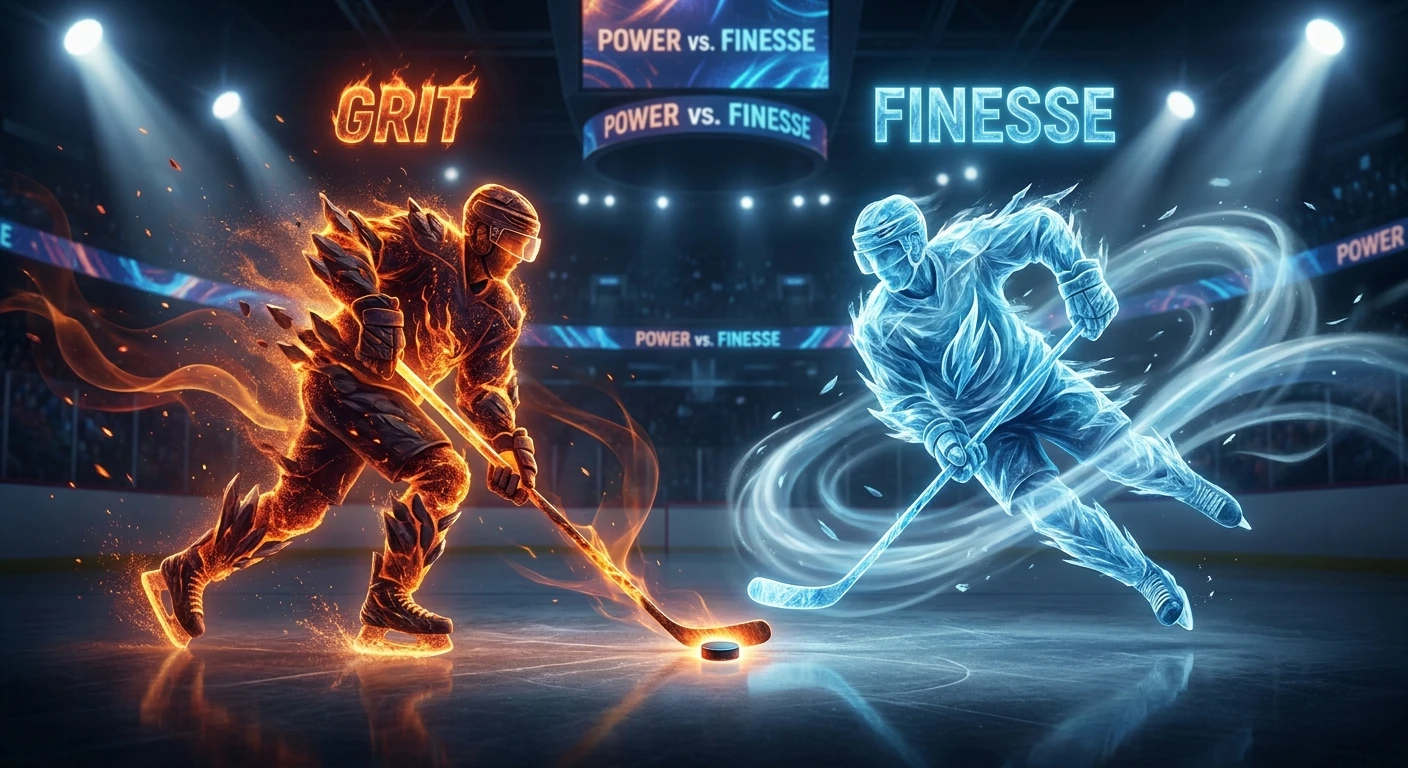
To really grasp how contrasting winger styles impact a game, you have to look at the foundational mechanics of how different players generate value on the ice. You basically have two completely different value propositions. On one hand, you have the heavy, agitating power-game approach. These guys thrive in the messy areas, creating utter chaos in front of the net, drawing penalties, and wearing down defensemen shift after shift. On the other hand, you have the cerebral, space-creation approach. These players almost look like they are playing a completely different sport. They rely on supreme edge work, spatial mapping, and elite vision to find passing lanes that regular humans simply cannot see. Both profiles are incredibly effective, but they bend the game to their will in totally different ways.
Take a look at how different winger profiles stack up when we break down their primary attributes:
| Player Profile | Primary Attribute | Ice Zone Dominance |
|---|---|---|
| The Agitating Power Forward | Physicality & Net-Front Presence | The Crease & Corner Boards |
| The Elite Playmaker | Vision & Puck Distribution | The Half-Wall & Neutral Zone |
| The Pure Sniper | Shot Release & Accuracy | High Slot & Faceoff Circles |
When general managers are piecing together a championship roster, they don’t just stack one type of player. They actively look to blend these traits. Here are three primary reasons why blending contrasting winger styles is a massive competitive advantage:
- Unpredictability in the Offensive Zone: When you have a line featuring a heavy forechecker alongside a slick puck distributor, defenders simply cannot use a single defensive scheme to shut them down. If you gap up tight to stop the passing, you get physically bullied. If you drop back to absorb hits, you leave passing lanes wide open.
- Special Teams Versatility: Your power play needs a guy who can wire cross-ice passes perfectly on the tape, but it equally needs a giant immovable object screening the goalie and banging in rebounds. You literally cannot have a top-tier unit without both skill sets functioning in harmony.
- Playoff Adaptability: The postseason is an entirely different beast. The games get tighter, the ice feels smaller, and the referees put their whistles away. Teams that only rely on finesse usually get pushed out of the series early, while teams that only rely on hitting eventually run out of scoring touch. You absolutely must have a balance.
Origins of Their Unique Hockey Styles
The roots of these divergent hockey styles trace back deeply into youth development programs. If you look at players who grow up heavily influenced by a gritty, old-school mentality, their entire minor hockey experience revolves around winning board battles and establishing dominance early in a shift. They are taught from day one that the quickest way to the net is a straight line through the opposing defender. Conversely, players who develop in heavily skill-based programs often spend their formative years doing edge-work drills, learning to open their hips, and practicing saucer passes over stacked pucks. They are explicitly trained to avoid contact and use open ice as their ultimate weapon.
Evolution Through the Draft Years
If we rewind the clock and look at how scouting has evolved, it is pretty fascinating. Ten years ago, scouts were notoriously biased toward size. A massive kid who could barely skate would still get drafted purely based on his potential to hit people. But as the game sped up, the purely physical players who lacked puck skills were systematically filtered out. The draft strategy completely shifted. Teams realized they needed a hybrid. They wanted players who possessed elite hockey IQ but could also survive the grueling physical toll of an 82-game season. Junior hockey leagues like the OHL became absolute breeding grounds for these highly specialized prospects. Some programs became famous for churning out incredibly polished, high-IQ playmakers, while others focused on developing rugged, hard-to-play-against power forwards.
The Modern State of Wingers
Right now, the modern NHL winger is expected to be somewhat of a chameleon. While a player might lean heavily toward being a physical agitator or a slick setup man, they absolutely must possess baseline competency in the opposite traits just to stay in the lineup. A power forward who cannot make a breakout pass is a liability, and a playmaker who refuses to take a hit to make a play will quickly find themselves benched. The standard has simply never been higher.
Advanced Analytics Explained Simply
When you start digging into the underlying numbers, the conversation shifts from eye-tests to hard data. We aren’t just looking at goals and assists anymore; we are tracking micro-events. Advanced analytics basically try to quantify what happens between the major events of a game. For example, Corsi is just a fancy way of counting shot attempts. If your team is shooting the puck more than the other team while you are on the ice, you generally possess the puck more. High-Danger Chances track shots taken from the slot and right around the crease—the areas where goals actually happen. As we look at the data coming out of the 2026 season, the tracking technology has become absurdly precise. We now have chips in the pucks and in the players’ jerseys tracking speed, total distance skated, and exactly how long a player holds onto the puck before making a decision.
The Geometry of Elite Playmaking
For the elite playmakers, hockey is basically a fast-paced game of geometry. They aren’t just passing to a static player; they are calculating speed, trajectory, and defensive stick placement in milliseconds. Let’s look at some of the wild analytical facts that truly illustrate the difference between average players and the absolute elite:
- Elite playmakers complete high-danger cross-ice passes at a rate nearly 40 percent higher than league average wingers.
- Top-tier power forwards generate over 60 percent of their total offensive output from within just 10 feet of the opposing net.
- Players utilizing highly effective edge work retain puck possession under direct physical pressure for an average of 1.4 seconds longer than average skaters.
- Controlled zone entries (skating the puck across the blue line rather than dumping it in) result in scoring chances nearly twice as often as dump-and-chase methods.
- Offensive zone possession time correlates directly with a dramatic reduction in penalties taken by the possessing team.
Day 1: Mastering Positional Awareness
If you want to genuinely understand how to evaluate elite wing play, you need a structured approach to watching game tape. On the very first day, your only goal is to watch a player without the puck. Completely ignore where the puck is going. Watch how the winger positions their body in the defensive zone. Are their shoulders squared to the defenseman? Are they constantly shoulder-checking to map out the incoming attackers? Positional awareness is the absolute bedrock of a high hockey IQ.
Day 2: Tracking Puck Progression
On your second day of tape study, focus entirely on transition hockey. Watch what happens the exact second a team regains possession of the puck in their own zone. Does the winger stretch the ice by flying up the boards, or do they swing low to provide a short passing option for their defenseman? This single decision dictates the entire pace of the team’s transition game.
Day 3: Evaluating Physical Impact
Day three is all about the physical toll of the game. But don’t just look for big, highlight-reel hits. Look for the subtle physical engagements. Watch how a winger uses their hips to seal off a defender along the wall to protect the puck. Watch how they fight through stick checks in the neutral zone. It is the micro-physicality that actually wins games, not just open-ice collisions.
Day 4: Breaking Down Power Play Setups
By day four, you should be isolating special teams. The power play is where elite traits are magnified because there is more time and space. Watch the umbrella setup. Focus on how a highly skilled playmaker uses deceptive eye movement to freeze the opposing penalty killers before snapping a crisp pass right through the seam for a one-timer.
Day 5: Analyzing Defensive Zone Exits
Now we switch focus to the hardest part of a winger’s job: getting the puck out of their own end safely. On day five, specifically watch wall-battles during a defensive zone exit. If a defenseman rims the puck around the glass, the winger has about half a second to chip it out before a 200-pound opponent crashes into them. It requires incredible bravery and soft hands simultaneously.
Day 6: Reading Off-Puck Movement
For your sixth day, shift your attention back to the offensive zone, but focus strictly on the weak-side winger—the player furthest from the puck. Elite offensive minds don’t stand still. They are constantly floating into the soft spots of defensive coverage, anticipating where the puck will be three seconds from now. This is exactly how quiet players suddenly end up with wide-open tap-in goals.
Day 7: Synthesizing the Complete Profile
On your final day of tape review, you bring it all together. You can now clearly identify when a player is driving the play physically versus when they are manipulating the play mentally. You will start to see the game exactly how professional scouts see it, completely moving past the simple box score and appreciating the nuanced mechanics that make these athletes genuinely incredible.
Myth: Finesse players cannot survive playoff hockey.
Reality: While the playoffs are undeniably more brutal, highly skilled playmakers actually dictate the pace of postseason games by utilizing space efficiently and avoiding unnecessary contact entirely. Their ability to cleanly enter the offensive zone is actually statistically more valuable than simply dumping the puck and hitting people.
Myth: Physical agitators lack high-end scoring touch.
Reality: Some of the greatest power forwards in history possess some of the softest hands around the net. You absolutely have to have elite hand-eye coordination to tip 90-mile-per-hour point shots while simultaneously wrestling a defenseman in the crease.
Myth: You need entirely one style to win a championship.
Reality: History shows that the most successful teams perfectly blend these styles. You need the heavy grit to exhaust the opponent, and you need the surgical skill to capitalize on the mistakes that the exhaustion creates.
Myth: Speed is the absolute only metric that matters anymore.
Reality: Straight-line speed is great, but hockey sense and processing speed are far more important. A slower player who thinks the game two steps ahead will always beat a faster player who lacks anticipation.
Do these players ever face off directly?
Yes, all the time. Wingers frequently clash along the boards during neutral zone transitions, creating highly visible contrasting style matchups.
How much do advanced stats actually matter?
They matter immensely to front offices for contract negotiations and roster construction, though coaches still rely heavily on video review and situational trust.
Is physical hockey fading away?
Not at all. It is simply changing. Pointless fighting is way down, but high-speed body checking and intense board battles are more aggressive than ever.
What makes a winger truly elite?
Consistency. An elite winger dictates the terms of the game on a nightly basis, regardless of whether they do it through hitting or passing.
Can you learn these specific hockey skills?
You can certainly drill edge work and passing techniques, but the extremely high-end spatial processing speed is often considered an innate talent.
Who ultimately drives play better?
It depends entirely on the game state. Playmakers drive possession numbers better, but power forwards drive high-danger zone entries more effectively during tight games.
What exactly is expected goals (xG)?
It is a statistical metric evaluating the quality of a shot based on historical data. It basically tells you how likely a specific shot from a specific location was to go in.
Understanding the deep intricacies of hockey makes watching the sport infinitely more enjoyable. Whether you prefer the absolute chaos of a heavy, grinding power forward or the poetic smoothness of an elite passer, there is no denying the spectacular athleticism involved in the modern 2026 NHL. The game continues to evolve rapidly, blending power and precision in ways we have never seen before. Keep breaking down the tape, keep questioning the old narratives, and be sure to subscribe to our newsletter for more deep dives into the analytics of professional hockey!